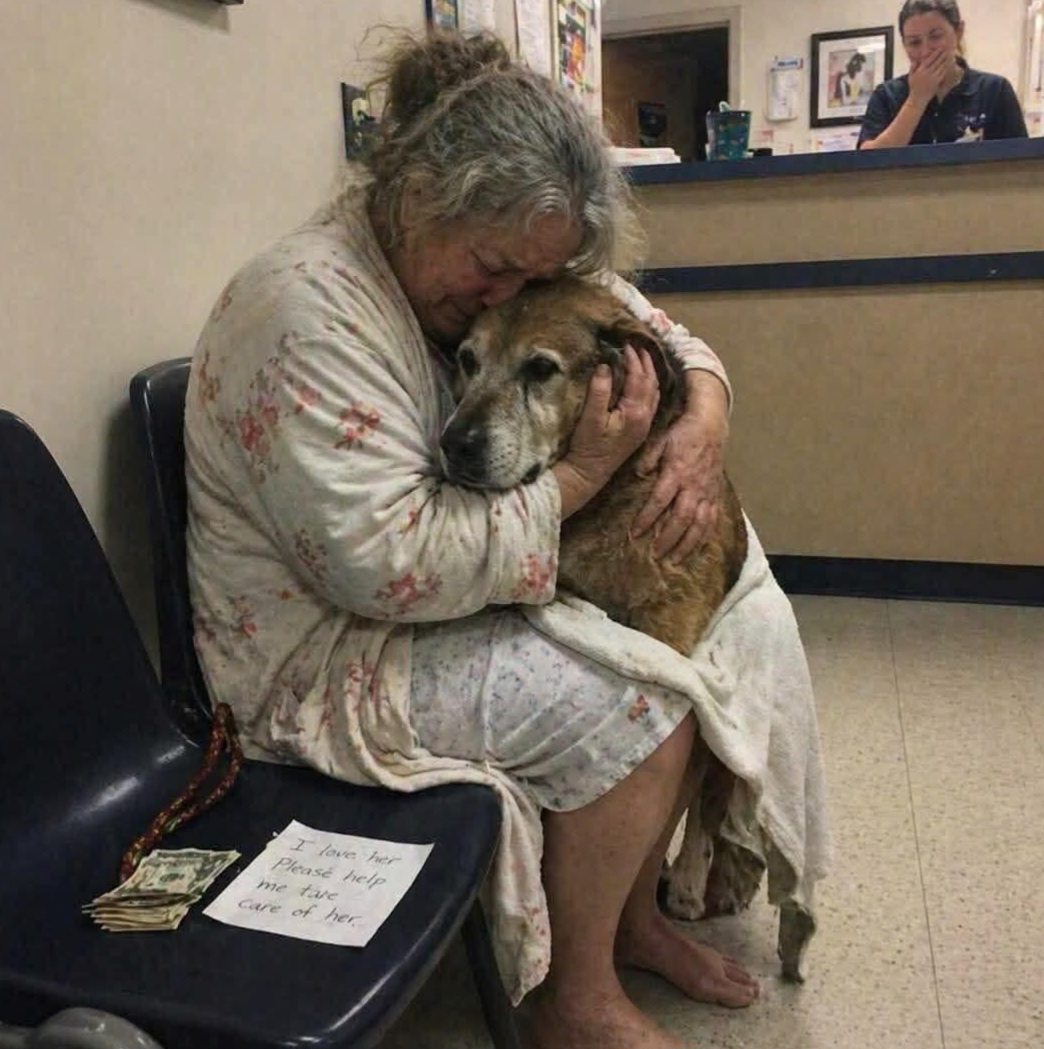
She walked three miles to the vet at 2 a.m. Barefoot. In her nightgown. She had $23 to her name. She set it on the counter and said, “This is everything I have. Please don’t let him d.i.e.”
She walked three miles to the vet at 2 a.m. Barefoot. In her nightgown. She had $23 to her name. She set it on the counter and said, “This is everything I have. Please don’t let him die.”
On a freezing Tuesday night in January 2023, an emergency veterinary clinic in a small city in central Ohio received a walk-in at 2:14 a.m. Not by car. Not by ambulance. A woman. On foot. In the dark. In twenty-eight-degree weather.
She was sixty-one. Wearing a thin bathrobe over a faded nightgown. No shoes. Her feet were raw — red, cracked, bleeding from miles of cold pavement. She hadn’t stopped to grab shoes. Hadn’t found a coat. She didn’t call a cab because she didn’t have a phone. She didn’t call anyone because there was no one to call.
In her arms, she carried a dog.
A large, aging mixed-breed — maybe part retriever — around twelve years old. Wrapped in a small towel. His body was limp. His breathing was fast and shallow, the kind that signals something is terribly wrong. His gums were pale. His eyes barely open.
She walked to the front desk and placed a small stack of money on the counter.
Twenty-three dollars. Everything she had.
Beside it, she set a handwritten note, torn from a notebook. It read:
“His name is Arthur. He is 12. He stopped eating 3 days ago. Tonight he collapsed and couldn’t stand. I don’t have insurance. I don’t have a car. I walked. This is all the money I have. I will pay the rest. I will do anything. Please help him. He is all I have.”
The receptionist looked at the money.
Then at the woman’s bare, injured feet.
Then at the dog.
She stepped away for a moment, covering her mouth.
The veterinarian on duty examined Arthur immediately. He was in acute kidney failure — something that can be treated if caught in time, but only with urgent care. He needed IV fluids, medication, monitoring.
The estimate was $1,400.
The woman had $23.
The vet didn’t hesitate.
“Start treatment,” she said. “We’ll cover it.”
They processed it as an emergency case. Paperwork could come later.
The woman refused to take her money back. She left it on the counter and sat in the waiting room — barefoot, wrapped in her robe, holding the empty towel Arthur had been wrapped in.
She didn’t ask for anything.
Not water.
Not coffee.
Nothing.
She just sat.
At 3 a.m., a technician brought her a pair of slippers and a blanket. She accepted the slippers.
She shook her head at the blanket.
“Give it to him,” she said.
By morning, the day staff had heard the story.
Arthur stabilized over the next three days. The fluids worked. His levels improved. On the second day, he ate a little. By the third, he stood. By the fourth, his tail wagged again.
And every day, she came back.
Walking the same three miles. Each way.
Six miles total.
In the cold.
Someone gave her shoes on the second day — a church nearby. She wore them without socks.
She sat in the same chair, holding the towel, waiting.
On the fourth day, they brought Arthur to her.
She held him the same way she had when she arrived — wrapped close, chin resting on his head. He pressed his face into her neck. She closed her eyes.
The vet told her there was no bill.
She shook her head and placed the $23 on the counter again.
“I owe you,” she said softly. “This is what I have. I’ll bring more when I can.”
The vet gently pushed it back.
“You walked three miles barefoot in the middle of the night to save him,” she said. “You don’t owe us anything. You already paid.”
The staff quietly pooled their own money. They sent her home with medication, special food, and a follow-up visit already covered.
A technician drove them home — the first car ride either of them had taken in over a year.
Her home was a small, single room behind another house. One bed. One chair. A hot plate. A worn dog bed. A ceramic bowl with “Arthur” written on it in chipped paint.
Two photos hung on the wall — one of a man, likely her late husband, and one of Arthur as a young dog.
Arthur recovered.
He’s older now, but still with her.
She learned how to give him fluids herself — something that once terrified her. But she did it anyway. For him.
And the $23?
She still keeps it, folded neatly in her nightstand.
She never spent it.
Because in her mind, it still belongs to him — waiting, just in case he ever needs it again.
The receptionist who read that note still has a photo of it saved on her phone. She never shared it publicly.
She just looks at it sometimes.
Because out of all the emergencies she’s seen, all the people with insurance, cards, and plans…
No one ever paid more to walk through that door than a woman who had nothing — and still gave everything.
And Arthur?
Every night, he sleeps under a roof.